
Here we are! The SYNCHROMODE project is drawing to a close. Together with ACUMEN, projects have joined forces for a Final Event that took place on 21 and 22 April in Brussels, that brought together cities, transport authorities, researchers and policymakers from across Europe.
Over the past three years, these projects have been testing AI-driven and data-driven solutions for multimodal traffic management across seven European cities.
Both projects presented their results and lessons learned, followed by live demonstrations of the SYNCHROMODE Toolbox and the ACUMEN Digital Twin running real-life scenarios from the pilot cities.
The call for contributions resulted in some really interesting additions to the programme, including presentations from:
• CARMONY – traffic orchestration for cross-border highway management, with insights from the Luxembourg pilot
• metaCCAZE – use cases for European cities
• Aalto University – Open Controller, an open and modular architecture for multi-modal traffic signal control
• Be-Mobile – Reflow, a flexible tool for fast what-if impact analysis of road network changes
• Mobilysis – uncovering micro-disruptions in traffic using drone-collected data
The day wrapped up with a panel discussion and a cocktail reception. 🥂
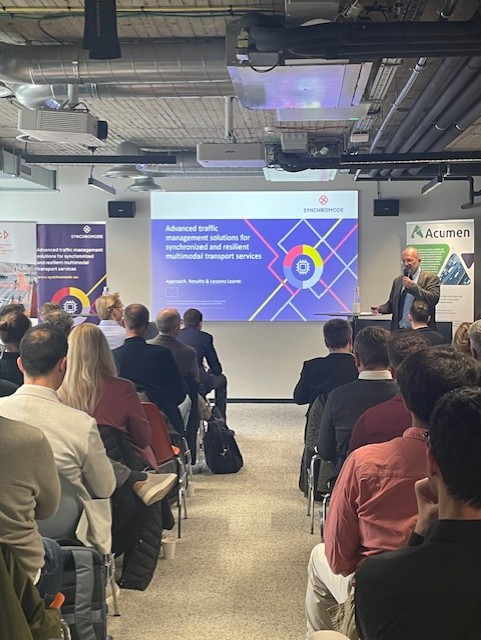
We began with policy and governance presentations from both projects, followed by a panel discussion on governance and data harmonisation – a crucial aspect of scaling up these solutions.
Later on, the focus shifted to the pilot cities. ACUMEN and SYNCHROMODE each shared the experiences, results and insights they had gained from their work in the field across their four and three pilots, respectively. In between, the tools demonstration and exhibition area gave participants a chance to try out the solutions for themselves.
The event closed with a panel discussion about the future of traffic management and an MTMC workshop, looking ahead to the next steps for multimodal traffic management in Europe.
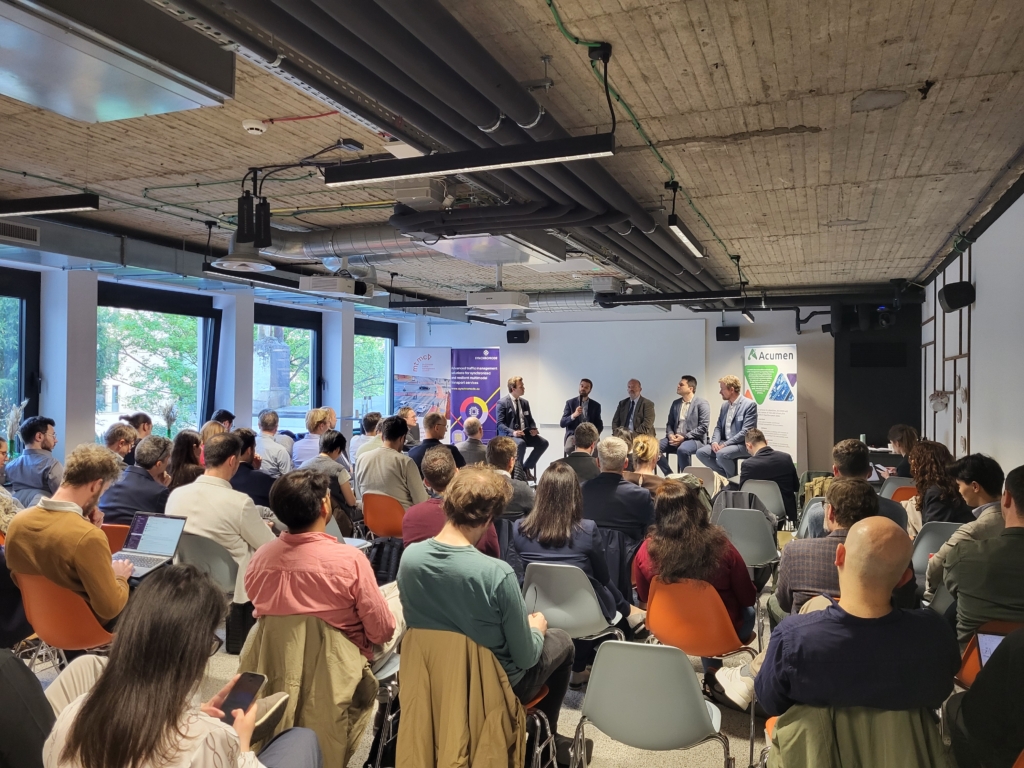

Looking forward, former and new projects of the Multimodal Traffic Management Cluster have met to discuss the next steps. While research is essential and needs to continue to be supported, for instance through Horizon Europe projects, we also need some efforts to ensure a greater outreach to market-ready solutions. The future of traffic management continues with projects sur as CARMONY, FEDORA, or Chorus, that are taking over!
Speaking at the closing panel, CINEA Project Officer Thiago Tavares noted that: ‘The main goal of these projects is to anticipate the future and test it out,’ he added, noting that ‘results like these can start shifting mindsets’.
Thank you to everyone who joined us in Brussels, contributed to the programme, and helped to make these two days such a success! 👏

